Silent haptics on a DualSense are worth diagnosing carefully, because the controller has two entirely separate vibration systems and people routinely troubleshoot the wrong one.
The main haptics come from voice-coil actuators, which are closer to small speakers than to the spinning weights in older controllers. That is why a DualSense can produce the sensation of rain or gravel rather than a generic buzz. The adaptive triggers use their own separate motors and have nothing to do with the haptic actuators. Losing one does not mean you have lost the other, and the fixes are different.
Here are eight fixes in the order worth trying.
Fix 1: check the console vibration setting
Start with the obvious one, because a setting gets changed more often than hardware fails.
On PS5: Settings, Accessories, Controller (General), Vibration Intensity. The options run from Off through Weak, Medium and Strong. Anyone who has ever turned haptics down to play late at night without waking the house has probably left it there.
Trigger Effect Intensity sits in the same menu and controls the adaptive triggers separately. If your triggers feel loose and springless but haptics still work, that is the setting to change.
Worth knowing that these are per-controller settings on some firmware versions. If you have two DualSense pads and one buzzes while the other does not, check the setting with each controller in hand.
Fix 2: check the game, not the controller
The DualSense haptics are a per-game feature and support is genuinely uneven.
Native PS5 titles built for the hardware use the actuators properly. PS4 games running through backwards compatibility generally get basic rumble instead, because they were written for the DualShock 4's conventional motors and the DualSense translates that into something simpler. Cross-generation releases vary depending on how much effort went into the PS5 version.
Many games also have their own vibration setting in their options menu, separate from the console-wide one. Both have to be enabled.
The quick test is to try a game you know uses haptics well. Astro's Playroom is installed on every PS5 and was built specifically to demonstrate them. If haptics work there and nowhere else, your controller is fine, and you have a game support question rather than a fault.
Fix 3: Charge it properly
Low battery reduces haptic strength before it stops it entirely, because the actuators draw meaningful current.
If your haptics feel weaker than they used to rather than absent, charge to full and test again before assuming anything is wrong. This is also why haptics can feel stronger on a freshly charged controller, which people sometimes report as the controller behaving inconsistently.
Test at above half charge for any diagnosis to be meaningful.
Fix 4: update the controller firmware
On PS5: Settings, Accessories, Controller (General), Device Software. Connect by USB and let it check.
Sony has shipped controller firmware updates that touched haptic behaviour, and a controller that has spent its life on a PC may never have received any of them. It takes a few minutes and rules out a whole category of problem.
While you are in the system settings, check that the console itself is fully updated too.
Fix 5: reset the controller
There is a small pinhole on the back of the DualSense, near the Sony logo beside the upper screw. Push a paperclip or SIM tool in and hold for about five seconds.
This clears stored controller state and pairings. Reconnect over USB afterwards and press the PS button.
It is a genuine fix for a controller whose haptics have stopped responding after a firmware update or a period of odd behaviour, and it costs you nothing beyond re-pairing.
Fix 6: test it somewhere else
This is the step that saves the most time, and the one people skip.
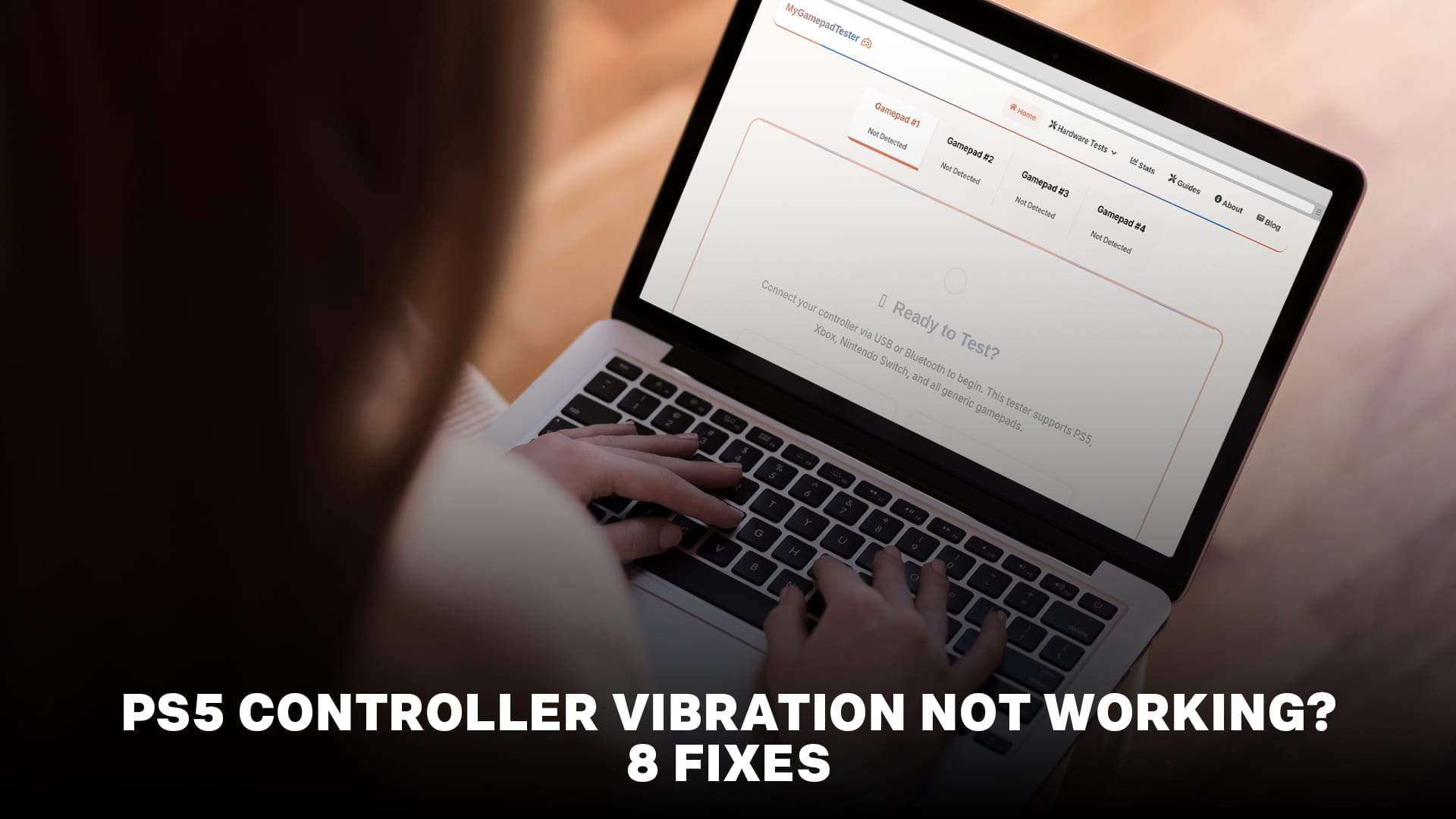
Confirm whether the controller can vibrate at all, independently of your PS5 and independently of any game. Connect it to a PC by USB and run a vibration test, which drives the actuators directly through the browser and tells you within seconds whether they respond.
If both sides respond in the browser, your hardware is fine and the problem is a console setting, a game, or a software layer.
If one side responds and the other does not, you have a failed actuator on one side. That is a hardware fault and no amount of settings work will fix it.
If neither responds, work through the remaining fixes and then consider repair.
While you have it connected, running the pad through a PS5 controller tester is worth the extra minute. Haptic failure after a drop often comes with other symptoms, and knowing whether the sticks and triggers are also affected changes whether repair makes sense.
Fix 7: PC-specific problems
If your haptics work on the console but not on your PC, this is where the answer is, and the short version is that PC support is limited by connection type and software layer.
Use USB rather than Bluetooth. The DualSense's full haptic capability is most reliable over a cable. Bluetooth support for the advanced features is inconsistent depending on the game and the software layer in use. If you are chasing haptics on PC specifically, plug it in.
Enable PlayStation Configuration Support in Steam under Settings, Controller. Steam Input handles DualSense rumble and haptics in supported titles, and without it many games fall back to nothing.
Check for conflicting software. DS4Windows, DualSenseX and reWASD all create virtual controllers. If one is running, the game may be talking to a virtual Xbox pad, which has no way to express DualSense haptics. Some tools have an output data setting that must be enabled for rumble to pass through at all, and turning it off to reduce latency also kills vibration. Run one layer, not two.
Expect translation loss. A game that receives your DualSense as a virtual Xbox controller gets basic dual-motor rumble at best, because that is all XInput can describe. The nuanced haptic effects do not survive the translation. This is a limitation rather than a fault.
Fix 8: when it is the hardware
If the browser test shows nothing on either side, the firmware is current, and a reset has not helped, you are looking at a hardware fault.
The common causes are a drop that has disconnected an actuator or its ribbon, liquid ingress, and simple failure of a voice coil after heavy use. A controller where one side works and the other does not is almost always a single failed actuator or its connection.
Repair is possible. The DualSense comes apart without special tools, though the ribbon cables are delicate and the battery sits awkwardly. Our DualSense troubleshooting guide covers the teardown and the faults worth attempting. If the adaptive triggers have failed alongside the haptics, which happens after a drop, the adaptive trigger repair guide is the relevant one.
Before opening anything, check warranty. Sony's manufacturer warranty runs twelve months in the US and Canada. In the UK and Germany, EU-derived consumer law generally gives you two years against the retailer you bought from rather than against Sony. Australian Consumer Law sets no fixed period and applies a reasonable expectation test instead, which has covered controller faults past the twelve-month mark. Opening the controller voids the manufacturer warranty everywhere, so exhaust that route first.
If you are weighing a repair against switching to a DualShock 4, which many people keep around for PC use, our DualShock 4 versus DualSense comparison covers what you gain and lose, including on the vibration side.
A note on what "working" should feel like
DualSense haptics are subtler than the rumble people are used to. If you have come from an Xbox pad or a DualShock 4, correctly functioning haptics in a quiet game can feel like nothing much is happening.
Before concluding they are broken, try Astro's Playroom, which pushes them hard enough that any doubt disappears. Several people who set out to fix silent haptics discover the feature was working the whole time and the game simply did not use it much.
Frequently Asked Questions
Q: Why did my DualSense vibration stop working suddenly?
Q: Are DualSense haptics the same as normal controller rumble?
Q: Why do my DualSense haptics not work on PC?
Q: One side of my controller vibrates and the other does not. What is wrong?
Q: Does low battery affect DualSense vibration?
Free Online Gamepad Tester
Test your controller for drift, deadzones, and input lag — no download required.
Launch Tester →